How often should a dryer vent be cleaned?
Once a year, and sooner if your clothes start taking longer to dry. That comes straight from the clothes dryer safety tip sheet from the National Fire Protection Association, which says to clean lint out of the vent pipe once a year, or more often if drying time creeps up, or to have a dryer lint removal service do it for you.
The lint filter is a separate and much smaller job. The same NFPA sheet says to clean it before or after each load. Whatever gets past the filter doesn't vanish. It settles in the hose behind the dryer and along the run to the outside wall or the roof, and the filter can't help you with any of that.
Why bother with the vent if I clean the lint screen every time?
Because lint that builds up where you can't see it is a real fire risk. The NFPA tip sheet is written for exactly that reason. It presents its advice, vent cleaning included, as simple steps that help prevent a clothes dryer fire.
So the habit has two halves. Empty the screen every load, and don't let the vent go years without anyone looking at it. The screen sits right in front of you every time you do laundry and the vent doesn't, so the vent is the half that gets forgotten.
Which of these sounds like your dryer?
The yearly rule is a floor. Where your house sits above it depends on how the dryer is behaving and what you know about its history, so find the situation that fits and go with the advice under it.
A normal load still dries in one cycle
You're on the standard schedule, which means once a year. Pick a month you'll remember and stick to it. In San Antonio, late fall works well, since it lands before holiday guests and the extra towels and bedding that come with them.
Loads are taking longer than they used to
Don't wait for the yearly date. Longer drying time is the exact cue the NFPA sheet names for cleaning sooner. Before you call anyone, go outside while the dryer is running and look at the vent flap. The NFPA says to make sure it opens when the dryer is operating, and if it barely moves, air isn't leaving the house the way it should.
You've just moved in and nobody knows when it was last done
Treat it as due now. If you've just moved in near JBSA, in Converse or Live Oak, you probably didn't get a service record for the dryer vent along with the keys. A vent that's been ignored for years won't announce itself until drying times slip, and you'd rather start your own clock from a known clean line.
The dryer runs most days
A big household, sports kit, towels every day and a dog that sheds all put more lint through the machine. Once a year is still the minimum, but check drying time and the outside flap every couple of months, and book the vent sooner the moment either one changes.
The hose behind the dryer is crushed or kinked
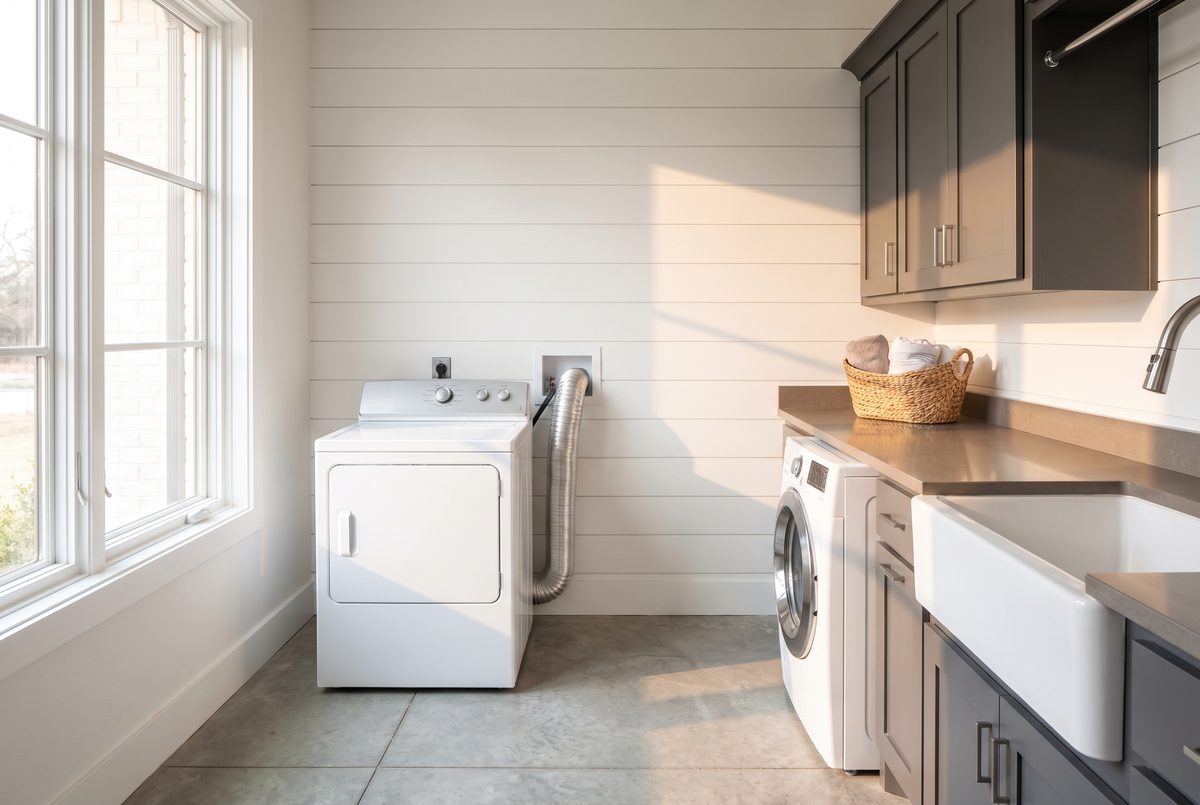
That's a fix-it-now problem, not a schedule question. The USFA clothes dryer fire safety flyer tells you to check the venting behind the dryer to make sure it isn't damaged, crushed or restricted. The NFPA sheet adds that rigid or flexible metal venting should be used to keep proper air flow and drying time, so a plastic hose, or any hose that has been flattened, is worth sorting out before the next load.
Not sure when your vent was last cleared?
Call or text (210) 300-0003 and we'll give you a firm quote before any work starts.
What can I check myself before booking?
Three things, and none of them need tools. Time a normal load and compare it with what you remember. Walk outside while it runs and watch the flap. Then pull the dryer out a little and look at the hose for flattened sections. The USFA flyer also reminds you to clean the back of the dryer, where lint can build up.
If it's a gas dryer, leave the gas connection alone while you're back there. The NFPA sheet says gas dryers should be inspected by a qualified professional to make sure the line and connection are intact and free of leaks, and that's not a job for a Saturday afternoon.
Short, straight runs are a reasonable DIY job, and the NFPA sheet treats doing it yourself as a normal option. Long runs through an attic or up to the roof are harder to reach end to end, which is usually when people call someone.
What happens when we clean a dryer vent?
Our dryer vent cleaning clears the line from the dryer all the way to the exterior vent, and then we confirm airflow afterwards so you know the air is actually getting out. You get a firm quote before work starts, with no surprise fees and no upselling at the door.
The people who come into your home are background-checked and performance-reviewed, and we're fully insured. If you'd rather ask us about that on the phone than take our word for it here, please do.
Worth clearing up while we're here: the dryer vent isn't part of your heating and cooling ducts, and clearing one does nothing for the other. If the HVAC side is on your mind too, we wrote up whether air duct cleaning is worth it in San Antonio, and air duct cleaning is its own service with its own quote.
Does anything about San Antonio change the schedule?
Not in a way anyone can put a number on. The NFPA reminder about snow covering the outdoor flap doesn't come up much here. What's worth a look in Helotes, Boerne or Alamo Heights yards is plainer: a shrub that's grown over the vent, a fence panel leaning on it, or yard gear stacked against the wall where the flap needs room to swing.
We work across San Antonio and the nearby cities with service-area pages, from Leon Valley to Shavano Park and Terrell Hills. Call or text (210) 300-0003, or use the free quote form, and you'll get a callback the same business day.
Get a firm quote on your dryer vent
Call or text (210) 300-0003 for a firm quote before any work starts, from a background-checked crew.